






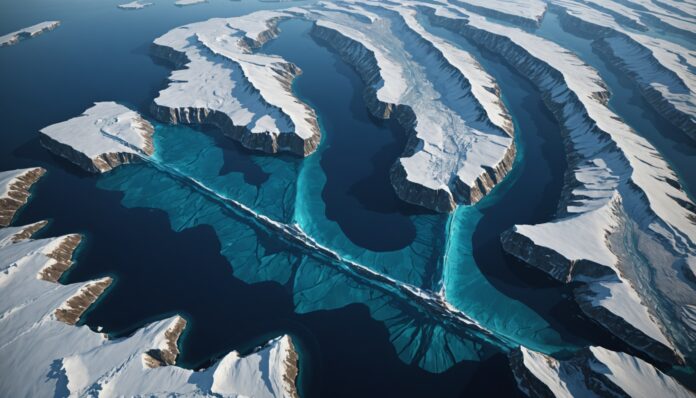

For a long time, the seafloor around Antarctica was pictured as a vast, monotonous plain buried beneath the ice sheet. A new mapping effort has upended that image: scientists have identified 332 underwater canyons around the white continent, roughly five times more than previously known. Published in the journal Marine Geology, this research reveals a spectacular, still largely unexplored landscape whose role in ocean circulation and climate evolution may have been underestimated.
A map that multiplies the known number of canyons by five
The study was led by David Amblàs of the University of Barcelona and Riccardo Arosio of University College Cork (Ireland). Rather than launching a new expedition, the researchers synthesized data from more than 40 international surveys, compiled in the second version of the International Bathymetric Chart of the Southern Ocean (IBCSO V2), the most detailed map to date of the seafloor in the region.
The result: where previous inventories counted only about sixty valleys, the new analysis identifies 332. Some are gigantic. The longest canyon, located in the Weddell Sea, stretches nearly 860 kilometers. Several valleys plunge beyond 4,000 meters deep, cutting into the continental slope with gashes comparable to the largest canyons on land.
Two geological faces, east and west
The catalog also highlights a marked difference between the continent's two sides:
- East Antarctica: longer, highly branched, and deep canyons, with characteristic “U”-shaped profiles shaped by ancient, prolonged carving.
- West Antarctica: shorter, steeper valleys with “V”-shaped profiles, a sign of more recent and more intense erosion.
This diversity is more than an aesthetic detail: it tells distinct geological stories and reflects different erosion dynamics, useful for reconstructing the region's glacial past.
Why these canyons matter for climate
Far from being mere geological curiosities, these structures act as true underwater highways. They guide exchanges between shallow coastal waters and deep offshore waters, transport sediments and nutrients, and shape habitats rich in biodiversity.
Above all, they can channel relatively warm water toward the base of ice shelves. This mechanism potentially accelerates the thinning of these floating barriers, which slow the flow of glaciers into the ocean. According to the authors, the influence of these canyons on ocean circulation and ice melt could therefore be greater than previously thought—a factor that should be incorporated into models forecasting sea-level rise.
What this means in practice
This discovery shows just how much of our planet remains uncharted. For climate scientists, having a reliable map of the Antarctic seafloor is essential: the models that simulate the behavior of polar oceans rely on seafloor topography. A more precise geometry of these canyons promises more robust climate projections. To learn more about environmental issues, check out our Planet section, and find more of our analyses in Science or International News.
Frequently asked questions
How many underwater canyons have been discovered around Antarctica?
The new mapping identifies 332, roughly five times more than previous inventories, which counted only about sixty.
How were these canyons identified?
The researchers did not conduct a new expedition: they analyzed data from more than 40 international surveys, compiled in the IBCSO V2 bathymetric chart of the Southern Ocean.
How do these canyons influence climate?
They facilitate water exchange between the coast and the open ocean and can carry warmer water toward ice shelves, which could accelerate their melting and affect global ocean circulation.
Sources
- Sci.News — Researchers Create Catalog of Antarctic Submarine Canyons
- ScienceDaily — 332 colossal canyons revealed beneath Antarctica's ice
- IFLScience — Over 300 Submarine Canyons Discovered Under Antarctica's Ice
S301: The 2026 Star Discovery That Will Put Einstein to the Test
At the heart of our galaxy, a star has just been spotted breaking every record: S301, detected using the European Southern Observatory (ESO), is hurtling around the Milky Way's supermassive black hole at the dizzying speed of 25,000 km/s, nearly…
Diplodocus Fossil Discovered in Spain Rewrites the History of Dinosaurs in Europe
A dinosaur genus once thought to be exclusively North American has just been identified in Europe. Spanish paleontologists from the Dinópolis Foundation have unearthed, at the El Castellar site (Teruel), the first fossil remains definitively attributed to the genus Diplodocus,…
Nasa's Roman Space Telescope Launches to Unravel the Mysteries of Dark Matter
NASA's Roman Space Telescope left Earth on August 30, 2026, at 7:26 a.m. Eastern time, aboard a SpaceX Falcon Heavy rocket launched from the historic LC-39A pad at Kennedy Space Center in Florida. Thirty-one minutes and forty-one seconds after liftoff,…
An Exoplanet Uncovered in TESS's Archives Thanks to an Effect Predicted by Einstein
This is a major first for the American space telescope TESS. An exoplanet named Gaia23bra b has just been identified in its data thanks to gravitational microlensing, a phenomenon predicted by Albert Einstein more than a century ago. The study…
This article was written with the help of artificial intelligence. Editorial policy
Table des Matières

