






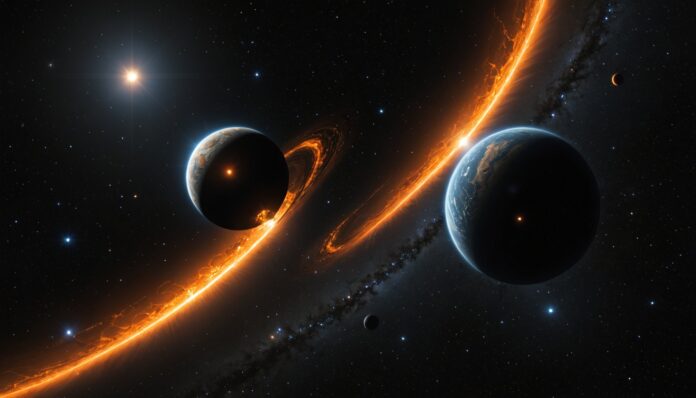

This is a major first for the American space telescope TESS. An exoplanet named Gaia23bra b has just been identified in its data thanks to gravitational microlensing, a phenomenon predicted by Albert Einstein more than a century ago. The study describing this discovery was published on July 1, 2026, in the journal The Astrophysical Journal Letters. Until now, this NASA satellite, launched to hunt for planets in a completely different way, had never uncovered a distant world using this method.
A Burst of Light Spotted as Early as 2023
It all began with an alert from the European Gaia telescope: in 2023, the observatory reported a sudden brightening of a star — hence the event's name, Gaia23bra. In re-examining their archives, astronomers found that TESS had also recorded this brief surge in brightness. Its cause was neither an explosion nor a variation in the star itself: it was the passage, in the foreground, of a star accompanied by a planet, whose gravity had momentarily amplified the light of the star located in the background.
This type of signal never repeats: the alignment between the two stars is a one-time coincidence. This is what makes archival data so valuable, since these fleeting events can be found after the fact.
Gravitational Microlensing, an Einstein Legacy
General relativity predicted it more than a hundred years ago: mass curves space-time. When a star passes exactly in front of another, much more distant one, its gravity acts like a magnifying glass and concentrates the light of the background star, which appears to shine more brightly for a few days or weeks. If a planet accompanies the “lens” star, it adds its own signature to the light curve: this is how Gaia23bra b gave away its presence.
Unlike the transit method — TESS's specialty, which watches for the tiny dip in brightness caused by a planet passing in front of its star — gravitational microlensing can detect worlds very far from their star, including tens of thousands of light-years away from us. According to researchers, it is currently the only technique capable of detecting Earth-mass planets on orbits comparable to our own.
Gaia23bra b, a Super-Jupiter 40,000 Light-Years Away
The confirmed characteristics of this newcomer are enough to make your head spin:
- Type: a “super-Jupiter,” meaning a planet more massive than the largest one in the solar system;
- Host star: an orange dwarf, smaller and cooler than the Sun;
- Distance: about 40,000 light-years from Earth;
- Orbit: a separation from its star comparable to the distance between Jupiter and the Sun.
This is a considerable distance: the vast majority of known exoplanets are much closer to us, only a few hundred or a few thousand light-years away.
Why This Discovery Matters
TESS was not designed for microlensing. Since its launch, it has been scanning the sky in search of transits, and its observations now span eight years. This unexpected success therefore turns its archives into a new hunting ground. “There are probably other microlensing planets hidden in the TESS data,” says Diana Dragomir, a member of the team behind the discovery — a prospect that, at this stage, remains a prediction rather than an established fact.
For astronomers, the stakes are high: combining several detection methods on a single instrument broadens the catalog of accessible worlds, from distant gas giants to rocky, Earth-like planets. To keep up with the latest space sector announcements, check out our Science and Tech / Net sections; those curious about the sky and the environment will also find plenty to enjoy in our Planet section.
Frequently Asked Questions
What Is Gravitational Microlensing?
It is an effect predicted by Einstein's general relativity: the gravity of a star (and any planet it may have) passing in front of a distant star briefly bends and amplifies that star's light. Analyzing this burst of light reveals the presence and certain properties of the planet.
Why Is This Detection a First for TESS?
The TESS telescope was designed for the transit method, which measures the dip in a star's brightness when a planet passes in front of it. Gaia23bra b is the first exoplanet identified in its data through gravitational microlensing.
What Do We Know About Gaia23bra b?
It is a super-Jupiter orbiting an orange dwarf star, about 40,000 light-years from Earth. It orbits at a distance from its star comparable to the distance between Jupiter and the Sun.
Sources
- Phys.org — TESS just found a planet in a new way
- EarthSky — Warped spacetime reveals exoplanet far from its star
- Universe Today — Bending spacetime reveals new planet hidden in archived TESS data
Nasa's Roman Space Telescope Launches to Unravel the Mysteries of Dark Matter
NASA's Roman Space Telescope left Earth on August 30, 2026, at 7:26 a.m. Eastern time, aboard a SpaceX Falcon Heavy rocket launched from the historic LC-39A pad at Kennedy Space Center in Florida. Thirty-one minutes and forty-one seconds after liftoff,…
Diplodocus Fossil Discovered in Spain Rewrites the History of Dinosaurs in Europe
A dinosaur genus once thought to be exclusively North American has just been identified in Europe. Spanish paleontologists from the Dinópolis Foundation have unearthed, at the El Castellar site (Teruel), the first fossil remains definitively attributed to the genus Diplodocus,…
A 1,000-Kilometer Icy Object Spotted Beyond Pluto, New Dwarf Planet Candidate
The solar system may have gained an additional dwarf planet. In late October 2026, the International Astronomical Union confirmed the discovery of an icy object nearly 1,000 kilometers in diameter orbiting far beyond Pluto, detected through the first observations of…
S301: The 2026 Star Discovery That Will Put Einstein to the Test
At the heart of our galaxy, a star has just been spotted breaking every record: S301, detected using the European Southern Observatory (ESO), is hurtling around the Milky Way's supermassive black hole at the dizzying speed of 25,000 km/s, nearly…
This article was written with the help of artificial intelligence. Editorial policy
Table des Matières

