






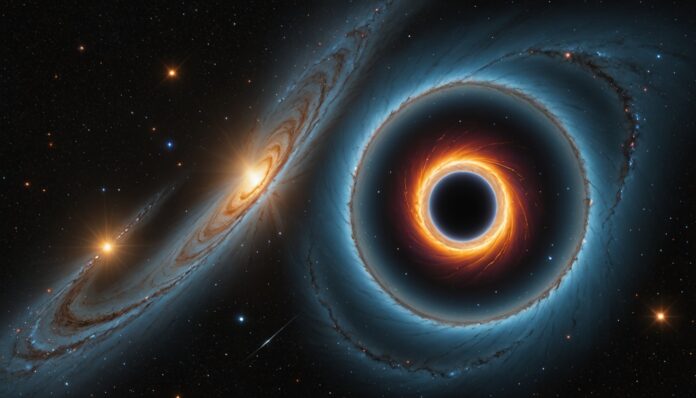

At the heart of our galaxy, a star has just been spotted breaking every record: S301, detected using the European Southern Observatory (ESO), is hurtling around the Milky Way's supermassive black hole at the dizzying speed of 25,000 km/s, nearly 8% of the speed of light. A discovery that goes beyond a simple observational feat: it could offer, within about a decade, one of the most rigorous tests ever conducted of Einstein's theory of general relativity.
A Star Racing at 90 Million km/h
S301 was first spotted in spring 2023 by the GRAVITY+ instrument, installed on the ESO's Very Large Telescope Interferometer (VLTI). After several years of monitoring needed to reconstruct its trajectory, astronomers confirmed that it is the fastest star ever observed in our galaxy. It orbits Sagittarius A*, the Milky Way's central black hole, whose mass is equivalent to about four million times that of the Sun.
- Orbital speed: about 25,000 km/s at closest approach to the black hole.
- Full orbital period: 8.7 years.
- Minimum distance to Sagittarius A*: 1.78 billion km, or about 12 times the Earth-Sun distance.
Why This Discovery Matters So Much to Physicists
What makes S301 exceptional isn't just its speed: it's its unprecedented proximity to the black hole. According to general relativity, a rotating black hole drags spacetime around it, a phenomenon known as the Lense-Thirring effect, which slightly distorts the orbit of surrounding objects. Until now, no known star was close enough to Sagittarius A* for this effect to be directly measurable. With S301, ESO researchers believe they finally have a candidate capable of providing the very first direct measurement of a black hole's rotation.
A Decisive Test, But One That Will Take Time
Patience remains the order of the day: according to the scientific team, at least two full orbits of S301 will need to be observed to achieve the necessary precision. The next closest approach to the black hole is expected in 2031, and a reliable measurement of Sagittarius A*'s rotation likely won't be available for about ten years. This timeline is far from trivial for fundamental physics: confirmation of the effect predicted by Einstein would further reinforce a century of theory, while an unexpected discrepancy would open the door to new physics.
A Wealth of Clues About Extreme Gravity
This discovery fits into a series of recent advances in testing relativity through observation. Astronomers, for instance, recently leveraged an exoplanet spotted thanks to a gravitational effect predicted by Einstein in archival data from the TESS telescope, proof that old datasets keep delivering surprises. In the hunt for dark matter, it is now the Roman Space Telescope that is set to take over in the coming years. More broadly, this work on fundamental physics connects with other areas of research into living systems, such as a recent study on the effects of physical exercise on the brain, a reminder that science advances just as much on the grandest scales as close to home. These topics naturally fit into tech and science news and more broadly into popular scientific culture.
Frequently Asked Questions
What is the star S301?
S301 is the fastest star ever detected in the Milky Way. It orbits very close to Sagittarius A*, the supermassive black hole at the center of our galaxy, at a speed of about 25,000 km/s.
Why does this star allow scientists to test general relativity?
Its proximity to the black hole makes it sensitive to the Lense-Thirring effect, a distortion of spacetime caused by the black hole's rotation, predicted by Einstein but never directly measured until now.
When will the first results be available?
The next closest approach to the black hole is expected in 2031. A reliable measurement of Sagittarius A*'s rotation will require observing at least two full orbits, putting the timeline at about ten years.
Sources
Nasa's Roman Space Telescope Launches to Unravel the Mysteries of Dark Matter
NASA's Roman Space Telescope left Earth on August 30, 2026, at 7:26 a.m. Eastern time, aboard a SpaceX Falcon Heavy rocket launched from the historic LC-39A pad at Kennedy Space Center in Florida. Thirty-one minutes and forty-one seconds after liftoff,…
Diplodocus Fossil Discovered in Spain Rewrites the History of Dinosaurs in Europe
A dinosaur genus once thought to be exclusively North American has just been identified in Europe. Spanish paleontologists from the Dinópolis Foundation have unearthed, at the El Castellar site (Teruel), the first fossil remains definitively attributed to the genus Diplodocus,…
A 1,000-Kilometer Icy Object Spotted Beyond Pluto, New Dwarf Planet Candidate
The solar system may have gained an additional dwarf planet. In late October 2026, the International Astronomical Union confirmed the discovery of an icy object nearly 1,000 kilometers in diameter orbiting far beyond Pluto, detected through the first observations of…
This article was written with the help of artificial intelligence. Editorial policy
Table des Matières

