






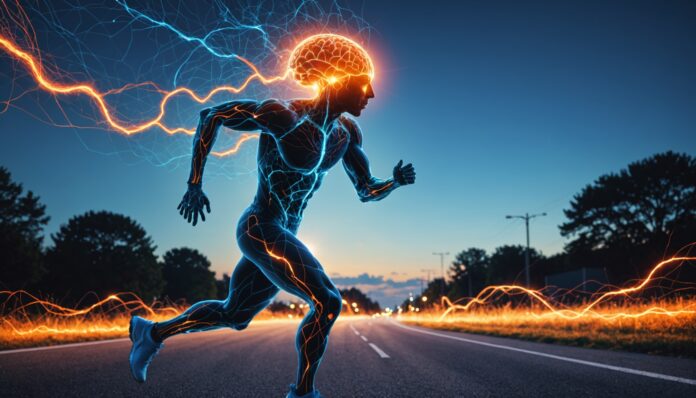

Exercise doesn't just build muscle in your legs or strengthen your heart: it also acts directly on your brain. A study published in early 2026 by researchers at the University of Cincinnati sheds new light on a phenomenon long debated by neuroscientists, adult neurogenesis, meaning the brain's ability to produce new neurons throughout life. Their work, published in the journal Nature Communications, shows exactly how physical exercise triggers this process.
A capacity long called into question
For decades, the scientific community debated whether neurogenesis actually occurs in the adult human brain. The question was largely settled in 2025: a study published in the journal Science confirmed that the hippocampus, the brain region responsible for memory and learning, does continue to produce new neurons in adulthood. According to the researchers' estimates, this process generates roughly 700 new neurons per day in this area, amounting to a renewal rate of about 1.75% per year.
The unexpected role of tiny blood particles
What's new about the Cincinnati study is the mechanism it identified. The researchers observed that physical exercise causes immune cells to release tiny particles called extracellular vesicles, which then circulate through the bloodstream. By injecting vesicles taken from mice that had exercised into sedentary mice, the team observed an increase in the production of new neurons in the hippocampus of the sedentary animals. In other words, the beneficial effect of physical activity on the brain may, in part, be transmitted through the blood rather than through a direct action of muscles on neurons.
BDNF, exercise's key messenger
This mechanism adds to another one that is already well documented: the release, during physical effort, of a protein called BDNF (brain-derived neurotrophic factor). As the Fondation pour la Recherche sur le Cerveau (the French foundation for brain research) points out, BDNF nourishes existing neurons and promotes the growth of new synaptic connections, particularly in the hippocampus. This same mechanism explains why regular physical activity is associated with better memory and learning performance, as confirmed by several studies reported by Scientific American.
These findings add to a conclusion already established by fitness specialists: as a previous article on the winning trio of exercise, sleep, and strength training pointed out, the benefits of physical activity are never limited to a single organ.
What type of exercise should you choose?
The researchers did not identify a single miracle exercise: consistency is what matters most. Aerobic activity (brisk walking, running, cycling) remains the best documented way to boost BDNF production, but strength training also appears to play a role, as our article on the evolution of strength-training machines already showed. Conversely, prolonged inactivity has the opposite effect: it is associated with a decline in neurogenesis, one more argument for remote workers, whose health effects are the subject of an increasing number of studies.
- Consistency: several sessions a week are more effective than a single intense workout.
- Endurance: brisk walking, running, and cycling remain the best-documented activities for boosting BDNF.
- Strength training: it complements the aerobic effect without replacing it.
- Inactivity: by contrast, it is associated with a slowdown in neurogenesis.
Frequently Asked Questions
Does the adult brain really produce new neurons?
Yes. A study published in the journal Science in 2025 confirmed that the adult human hippocampus continues to produce new neurons throughout life, at a rate estimated at around 700 per day.
How does physical exercise affect the brain?
It stimulates the release of BDNF and, according to a 2026 study from the University of Cincinnati, the production of extracellular vesicles that circulate in the blood and promote the birth of new neurons in the hippocampus.
Do you need a specific type of exercise to benefit?
No single miracle exercise has been identified: consistency of practice, particularly aerobic activity combined with strength training, appears to be the most determining factor.
Sources
Remote Work and Health: What Recent Studies Show
In France, remote work has become a lasting part of working habits, but its effects on employees' health continue to raise questions among researchers and institutions. Between well-documented physical risks, psychological isolation, and real benefits for certain profiles, the studies…
Sleep Loss and Weight Gain: The Real Culprit Isn't Hunger
Sleep loss has long been presented as a simple matter of fatigue. A recent American study, however, challenges a deeply rooted assumption: it's not hunger that drives weight gain when we sleep less, but rather the drop in energy that…
This article was written with the help of artificial intelligence. Editorial policy
Table des Matières

