






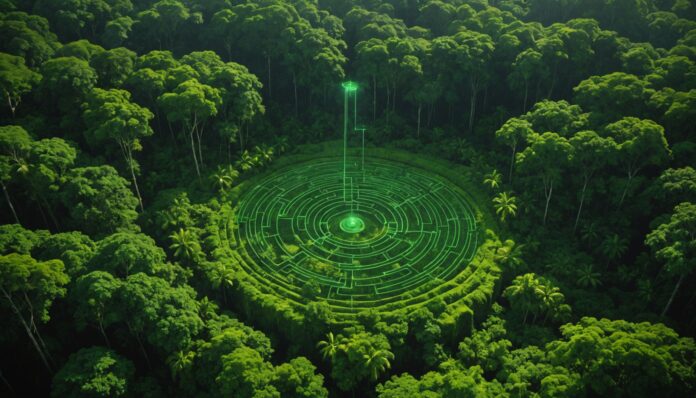

Beneath the dense canopy of the southwestern Amazon, researchers have just uncovered the remains of a lost Amazonian civilization that may have numbered up to several million inhabitants. The discovery, made possible by aerial surveys equipped with LiDAR sensors, upends the long-held assumption that the rainforest remained untouched by urbanization before the arrival of Europeans.
A Technology That Pierces the Canopy
LiDAR (light detection and ranging) sends laser pulses through the foliage to reconstruct, with centimeter-level precision, the shape of the ground below. Scientific teams flew more than 4,400 kilometers and mapped roughly 4,500 square kilometers of dense forest, an area that had been nearly impossible to explore on foot given how impenetrable the vegetation is.
This technique, already used at other archaeological sites around the world, once again demonstrates its ability to reveal human-made structures that have been invisible beneath vegetation for centuries.
Nearly 400 New Structures Identified
The surveys revealed 396 new geoglyphs — large geometric figures formed by deep ditches and earthen mounds — along with more than 400 distinct sites. Some correspond to ancient dwellings, while others appear to have served cultural, political, or religious purposes.
- More than 4,400 kilometers flown by aircraft equipped with laser sensors
- Roughly 4,500 square kilometers of Amazon rainforest mapped
- 396 previously unknown geoglyphs uncovered
- More than 400 archaeological sites recorded in total
- A civilization active from the 6th century BCE to the 8th century CE
An Urbanized Civilization Long Before Colonization
According to researchers, this society may have numbered up to several million inhabitants at its peak, spread across a network of interconnected communities. This estimate adds to a growing body of evidence, gathered in recent years across several regions of the Amazon, suggesting that the pre-Columbian Amazon basin was home to societies far more organized and populous than previously imagined.
Scientists also estimate that more than 20,000 similar structures may still lie hidden beneath the canopy, in areas not yet surveyed from the air. Each new LiDAR campaign conducted in the Amazon adds to the map of a continent whose human history, for the most part, remains to be written.
Why This Discovery Matters
Beyond its archaeological significance, this research raises questions about how human societies can sustainably occupy a tropical environment without destroying it. Understanding how this civilization organized its territory for more than a millennium could, according to some researchers, inform current thinking on the sustainable management of large tropical forests.
To explore more of the major issues facing our planet, head to our Planet section, or for other major discoveries, check out our Culture section. Tech enthusiasts can also visit our Tech / Internet section to learn how these laser mapping tools are used in other fields.
Frequently Asked Questions
What is the LiDAR technology used for this discovery?
It is an aircraft-mounted laser remote-sensing system capable of penetrating the forest canopy to precisely map the shape of the ground below, including any human-made structures buried or hidden by vegetation.
How long did this civilization exist?
The data collected place its development between the 6th century BCE and the 8th century CE, meaning more than a thousand years of continuous occupation of the region.
Are more discoveries of this kind expected?
Yes: researchers estimate that tens of thousands of structures may still be hidden beneath the Amazon rainforest, in areas that have not yet been covered by aerial surveys.
Sources
Sciencepost.fr —
Archaeology News Online Magazine —
Journal du Geek
Nasa's Roman Space Telescope Launches to Unravel the Mysteries of Dark Matter
NASA's Roman Space Telescope left Earth on August 30, 2026, at 7:26 a.m. Eastern time, aboard a SpaceX Falcon Heavy rocket launched from the historic LC-39A pad at Kennedy Space Center in Florida. Thirty-one minutes and forty-one seconds after liftoff,…
World's Oldest Amber: 385 Million Years That Rewrite Plant History
A piece of fossilized resin no bigger than a pinhead has just upended an entire chapter in the history of life on Earth. Paleontologists have announced the discovery of the world's oldest amber, roughly 385 million years old, unearthed from…
Unprecedented Underground Anomaly Detected Near the Pyramids of Giza
Beneath the plateau of the Pyramids of Giza, a geophysical survey has just revealed an unexpected underground anomaly, just a few hundred meters from the Great Pyramid. According to a study published in the scientific journal Archaeological Prospection, a team…
Diplodocus Fossil Discovered in Spain Rewrites the History of Dinosaurs in Europe
A dinosaur genus once thought to be exclusively North American has just been identified in Europe. Spanish paleontologists from the Dinópolis Foundation have unearthed, at the El Castellar site (Teruel), the first fossil remains definitively attributed to the genus Diplodocus,…
This article was written with the help of artificial intelligence. Editorial policy
Table des Matières

