






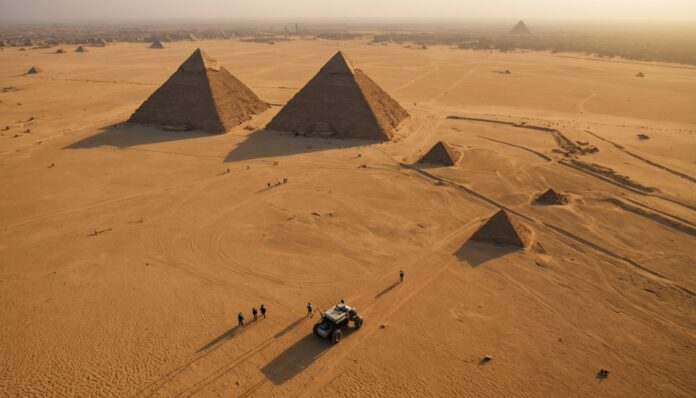

Beneath the plateau of the Pyramids of Giza, a geophysical survey has just revealed an unexpected underground anomaly, just a few hundred meters from the Great Pyramid. According to a study published in the scientific journal Archaeological Prospection, a team of Japanese and Egyptian researchers combined ground-penetrating radar and electrical resistivity tomography to probe the subsurface of the Western Cemetery, an area until now considered devoid of remains. The result: two distinct structures, buried for roughly 4,500 years, whose exact function remains to be determined.
A Radar That Reveals What the Sand Has Hidden for Millennia
The Western Cemetery at Giza traditionally houses mastabas, the rectangular tombs reserved for relatives of the pharaohs and high officials of the Old Kingdom. The area surveyed by the research team, however, was considered flat and unoccupied ground. Measurements using ground-penetrating radar revealed a first L-shaped structure, roughly ten by fifteen meters, located between 0.5 and 2 meters deep.
Deeper down, between 3.5 and 10 meters below the surface, the researchers identified a second, more massive structure, roughly ten by ten meters. The scientists suggest the L-shaped structure may have served as access to this deeper chamber — a layout that would echo the architecture of certain Old Kingdom Egyptian tombs, though this has not been confirmed at this stage.
A Discovery That Adds to a Banner Season for Archaeology
This find is part of a broader movement to reread the Egyptian subsurface using non-invasive technologies. As with the mapping of the distant universe conducted by the Roman space telescope, it is cutting-edge instrumentation that today makes it possible to push the boundaries of scientific exploration without disturbing the ground. The study's authors remain cautious: no excavation or drilling has yet been undertaken to confirm the nature of the anomaly.
This caution is not incidental. Earlier claims about vast structures hidden beneath another pyramid on the plateau, based on satellite radar imagery, were widely criticized by the scientific community before being retracted from a publication due to methodological errors. This episode illustrates just how essential scientific rigor remains when dealing with geophysical data that always requires verification on the ground.
Why This Area Had Never Been Explored
Unlike the immediate surroundings of the pyramids, extensively excavated since the 19th century, certain margins of the Western Cemetery had long been considered unpromising by successive archaeological teams. This anomaly is a reminder that major discoveries keep emerging in places long thought to be already well known, whether ancient remains or fossils millions of years old.
If the hypothesis of a forgotten tomb is confirmed, it would add to the already dense mapping of the Giza plateau, with its mastabas, funerary shafts, and temples. The expected next steps include targeted surveys and, if authorization is granted by the Egyptian authorities, limited excavations aimed at verifying the exact nature of the cavity detected beneath the sand.
Beyond ancient Egypt, this non-destructive exploration method is also of interest to other disciplines, from astrophysics tracking the most extreme objects in the universe to geophysics applied to heritage preservation. In our Science section, these instrumental advances are followed as new publications emerge, as are preservation issues covered in our Planet section. Advances in radar and electrical tomography also fall under the tools featured in our Tech / Net section.
Frequently Asked Questions
What is an underground anomaly in archaeology?
It refers to an area of the subsurface whose physical properties (density, electrical resistivity) differ from the surrounding ground, which can indicate a cavity, a masonry structure, or an artificial void. On its own, it does not confirm the presence of an archaeological remain.
What techniques enabled this detection near Giza?
The researchers combined ground-penetrating radar, which sends electromagnetic waves into the ground, with electrical resistivity tomography, which measures how the subsurface conducts electricity. Both methods are non-invasive and require no excavation.
Is an excavation planned to verify this discovery?
At this stage, no excavation has been publicly announced. The research teams recommend further verification before any excavation, particularly to avoid the interpretation errors already seen in other radar surveys conducted on the Giza plateau.
Sources
A 1,000-Kilometer Icy Object Spotted Beyond Pluto, New Dwarf Planet Candidate
The solar system may have gained an additional dwarf planet. In late October 2026, the International Astronomical Union confirmed the discovery of an icy object nearly 1,000 kilometers in diameter orbiting far beyond Pluto, detected through the first observations of…
Nasa's Roman Space Telescope Launches to Unravel the Mysteries of Dark Matter
NASA's Roman Space Telescope left Earth on August 30, 2026, at 7:26 a.m. Eastern time, aboard a SpaceX Falcon Heavy rocket launched from the historic LC-39A pad at Kennedy Space Center in Florida. Thirty-one minutes and forty-one seconds after liftoff,…
An Exoplanet Uncovered in TESS's Archives Thanks to an Effect Predicted by Einstein
This is a major first for the American space telescope TESS. An exoplanet named Gaia23bra b has just been identified in its data thanks to gravitational microlensing, a phenomenon predicted by Albert Einstein more than a century ago. The study…
S301: The 2026 Star Discovery That Will Put Einstein to the Test
At the heart of our galaxy, a star has just been spotted breaking every record: S301, detected using the European Southern Observatory (ESO), is hurtling around the Milky Way's supermassive black hole at the dizzying speed of 25,000 km/s, nearly…
This article was written with the help of artificial intelligence. Editorial policy
Table des Matières

