






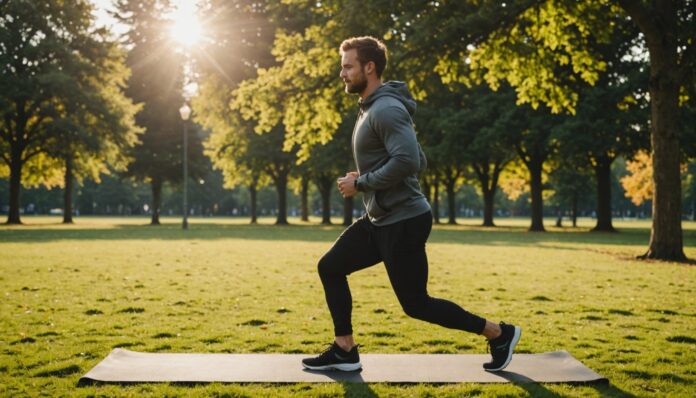

French people have never been more active: according to the latest official barometer, more than six people in ten now engage in regular sports activity in France. But a recent scientific study puts this good number in perspective: to be truly fit, walking isn't enough. Here's why.
Sports Participation at an All-Time High in France
According to the National Barometer of Sports Participation, conducted by Injep (France's national institute for youth and community education research) on behalf of the ministry in charge of Sports among a sample of more than 4,000 people, 61% of French people ages 15 and older say they practice a sports activity at least once a week. That's two points higher than before the Paris Olympic and Paralympic Games, and seven points higher than in 2018. Broadening the scope to occasional participation, 72% of French people did some form of sports at least once over the past twelve months, six points higher than eight years ago. Walking and running remain the most widespread activities, driven largely by a quest for well-being rather than competition.
Walking Alone Isn't Enough, According to a Study of 400,000 Adults
That's where the problem lies. An American study conducted by West Virginia University, published in the scientific journal PLOS One, analyzed the habits of nearly 400,000 adult walkers. The result: only 25% of them meet both the recommended level of aerobic activity and the recommended threshold for muscle strengthening. Worse, about 22% of regular walkers meet neither criterion, despite counting their steps every day.
The official public health recommendations, cited by the researchers, are nonetheless clear:
- between 150 and 300 minutes of moderate aerobic activity per week (brisk walking, cycling, swimming);
- at least two weekly muscle-strengthening sessions, targeting the main muscle groups.
Without this second component, walking alone protects the heart and circulation, but leaves out muscle mass, balance, and bone strength — factors that are nonetheless critical for staying independent with age.
How to Easily Supplement Your Daily Walk
The good news: there's no need to sign up for a gym to fix this. The researchers recommend incorporating simple exercises that can be done at home or outdoors:
- squats or lunges, for the legs and lower body;
- core work, for the abs and back;
- exercises with light weights or resistance bands, for the arms and shoulders;
- brisk stair climbing, which combines cardio and strength training.
Two short 20- to 30-minute sessions per week are already enough to close most of the gap identified by the study, without upending a busy schedule.
Key Takeaways
Sports participation is on the rise in France, driven by the effect of the Olympic Games and a growing general awareness around well-being and health prevention. But walking, however beneficial, covers only part of the body's needs. Adding a few minutes of muscle strengthening per week to your walks or daily strolls remains, according to the researchers, the simplest way to achieve truly complete physical fitness, alongside a more traditional sports routine.
Frequently Asked Questions
Why isn't walking alone enough to stay fit?
Because it mainly works cardiovascular endurance but does little to build muscular strength. Public health recommendations also call for regular muscle strengthening, which walking alone doesn't provide for most walkers, according to the study published in PLOS One.
How much physical activity is recommended each week?
Health authorities recommend between 150 and 300 minutes of moderate aerobic activity per week, combined with at least two muscle-strengthening sessions targeting the main muscle groups.
What simple exercises can be added to a daily walk?
Squats, core work, exercises with light weights or resistance bands, or brisk stair climbing are enough — done in two short sessions per week — to round out the benefits of walking.
Sources
- sports.gouv.fr – Sports Data in France, Injep Barometer
- Futura-Sciences – Why Walking Alone Wouldn't Be Enough to Be in Great Shape
- e-Santé – Why Walking Is No Longer Enough: A Study of 400,000 Adults
Air Conditioning and Heat Waves: Benefits, Risks, and Tips
After an episode of exceptionally severe heat last June, air conditioning is becoming increasingly common in French households. But between thermal comfort and real health risks, what does science actually say? Here's what you need to know to protect yourself…
Septembre Bouge: France Relaunches Physical Activity for Back-to-School
From September 1 through September 30, France is holding its very first edition of Septembre Bouge (France's new “Move in September” campaign), the national month dedicated to physical activity and sports led by the Ministries of Sports and Health. This…
Mental Health at Work: Employee Well-Being Improves, But Stigma Persists
The French government has confirmed the extension into 2026 of the National Priority Cause (an annual awareness campaign designated by the French government) devoted to mental health, under the title “Let's Talk About Mental Health!” The decision coincides with the…
Kombucha and Kefir: What These Fermented Drinks Really Do for Your Health
On supermarket shelves in France, bottles of kombucha and kefir have taken up a spot nobody would have predicted three years ago. Driven by a generation looking for alternatives to soda, these fermented drinks are posting spectacular growth — but…
This article was written with the help of artificial intelligence. Editorial policy
Table des Matières

