






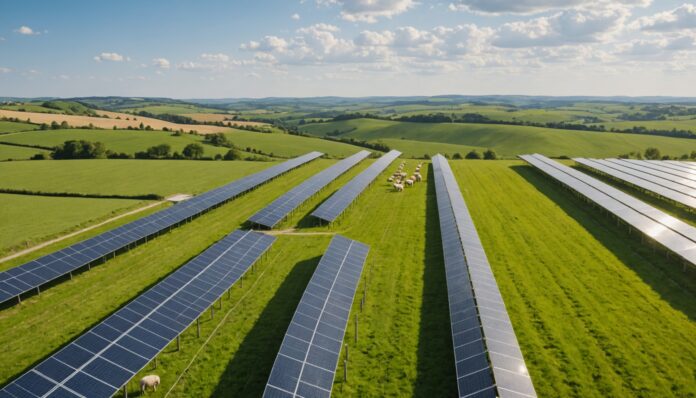

On French solar farms, a small revolution is advancing on four legs. Sheep agrivoltaics — raising sheep under and between photovoltaic panels — is no longer an experimental curiosity: it is establishing itself as a serious model of dual land use. And the results from the field hold a surprise. Far from simply mowing the grass, the flocks also appear to help improve the output of the installations. Here's a closer look at this unexpected partnership between livestock farming and energy.
One Piece of Land, Two Outputs
The principle is simple: instead of pitting farmland against solar plants, agrivoltaics makes them coexist. The panels produce electricity; underneath, sheep graze on grass they naturally keep in check. According to the German institute Fraunhofer, a global reference on solar energy, this combination can increase the overall efficiency of land use by up to 60%, since it simultaneously generates food, energy, and ecological services.
In France, the sector is taking shape. A 2024 study conducted by INRAE (the French National Research Institute for Agriculture, Food and Environment) with energy companies Statkraft and CVE confirmed the positive effects of sheep grazing under panels. The first solar farm of this kind in the Jura region is expected in the towns of Arbois and Abergement-le-Grand.
The Unexpected Effect: More Efficient Panels
This is the point that intrigues farmers and plant operators alike. By grazing, sheep keep vegetation low and alive around the modules. This plant cover cools the surrounding air: photovoltaic panels, which perform better when they run cooler, can then generate slightly more electricity. The size of the gain depends on the climate and the type of soil, but the mechanism is real — a virtuous circle in which the animals' presence directly serves energy production.
Conversely, the panels do the flock a favor by providing shade. This mutual benefit sets agrivoltaics apart from a simple overlap of uses: each side benefits from the other.
What This Means in Practice for Farmers
- Less mechanical upkeep: sheep replace mowers and brush cutters, cutting costs and reducing the use of herbicides.
- Preserved forage: the shade slows grass growth and keeps it from scorching during heat waves, extending the available resource.
- Extra income: making the land available secures the farm against climate and market uncertainty.
- Stored carbon: well-managed grazing can increase soil carbon stocks by 10% to 80%, according to North American research.
Animal Welfare: The Biggest Winner
In Australia, a large-scale study of roughly 1,700 merino sheep showed that the animals use the shade from the panels to better withstand heat and produce higher-quality wool. Sheltered and less stressed, the animals spend more time resting and ruminating. This added comfort benefits the flock's health and, ultimately, the profitability of the farm.
Necessary Safeguards
The model's success also draws scrutiny. Advocacy groups and environmental defenders point out that an agrivoltaic project must remain in service of agriculture, not the other way around: livestock farming must not become a mere pretext for covering land with panels. The common-sense rule is widely agreed upon: agricultural production must remain the primary activity, with energy serving only as a supplement. Under these conditions, sheep and solar power form a promising duo for the ecological transition.
Frequently Asked Questions
What is sheep agrivoltaics?
It is the combination, on the same plot of land, of solar electricity production and sheep farming, with the flock grazing under the panels. The two activities benefit each other: land upkeep on one side, shade and shelter on the other.
Do sheep really improve panel output?
Indirectly, yes. By maintaining low vegetation that cools the environment around the modules, they limit how much the panels heat up; and a cooler panel produces slightly more electricity. The size of the gain varies depending on the climate and soil.
Is this model profitable for farmers?
It reduces land maintenance costs and provides extra income, while also preserving forage. Profitability, however, depends on flock size and the terms of the contract signed with the solar farm operator.
Sources
- L'Energeek — 40 sheep under solar panels
- JVTech — A study of 1,700 sheep
- France 3 Régions — An agrivoltaic farm in the Jura
Alstom's Belfort Plant Ramps Up: New Locomotives, New Building, 200 New Jobs
In the Territoire de Belfort, the Alstom plant is heading into a packed fall season. Chosen to produce an entirely new line of locomotives meant to replace an aging diesel fleet, the Belfort industrial site is also announcing the upcoming…
American Giant Liver Fluke: A New Parasite Takes Hold in French Deer
A parasite previously unknown on French soil has just been detected in the liver of a fallow deer in Sologne. Named the American giant liver fluke (Fascioloides magna), this invasive species native to North America attacks wild deer and is…
Biodiversity in France: What the New European Report on Species Status Reveals
A new scientific report serves as a reminder that biodiversity in France continues to decline, despite decades of protection policies. Published in early September by the National Museum of Natural History and the French Biodiversity Office, this document—largely overlooked by…
Japanese Beetle in France: Why This Insect Is Causing So Much Concern in 2026
Since the start of summer 2026, a small metallic beetle with coppery-green highlights has been keeping France's plant health monitoring services busy. The Japanese beetle (Popillia japonica) has been detected several times across the country, reviving concern among farmers and…
This article was written with the help of artificial intelligence. Editorial policy
Table des Matières

