






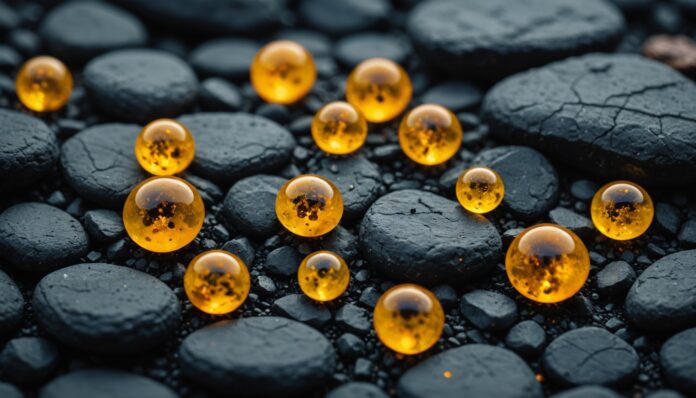

A piece of fossilized resin no bigger than a pinhead has just upended an entire chapter in the history of life on Earth. Paleontologists have announced the discovery of the world's oldest amber, roughly 385 million years old, unearthed from a coal seam in northwestern China. The find, published on July 15, 2026 in the journal Science Advances, pushes back the previous record by 65 million years and reveals that some plants were already producing resin long before the first seed-bearing trees appeared.
A resin older than the first conifers
Until now, the oldest known amber dated back about 320 million years, to the end of the Carboniferous period, in the United States. The 241 fragments described by the team led by researcher Cihang Luo (Nanjing Institute of Geology and Paleontology, Chinese Academy of Sciences, in collaboration with the Senckenberg Research Institute) date instead to the Middle Devonian. They come from the Hujiersite geological formation, near Hoxtolgay, in the Xinjiang region.
At that distant time, no animal had yet ventured onto dry land for good, and seed-bearing trees did not exist. The resin therefore could not have come from conifers, as is the case for most amber known today. It was likely produced by primitive plants, such as progymnosperms or tree-like lycopsids, those distant cousins of ferns that dominated Devonian landscapes.
Spotted by chance, under ultraviolet light
The discovery owes a lot to luck and to good methodology. While searching for coal to study Devonian flora, the scientists shined ultraviolet light on their samples: tiny fluorescent blue dots appeared, the characteristic signature of amber. The fragments, most measuring between 0.1 and 0.5 millimeters, had gone unnoticed until this simple test.
What remained was to prove that this was indeed fossilized resin. Analyses using infrared spectroscopy and gas chromatography-mass spectrometry yielded a chemical composition close to that of modern and fossil conifer resins. A result as valuable as it was unexpected, since it concerns plants that have been extinct for hundreds of millions of years. As is often the case in science, caution is warranted: further analyses will be needed to confirm or refine the identification of the plants that produced it.
Why this discovery matters
Beyond the record itself, this Devonian resin opens up several concrete avenues for understanding ancient ecosystems and plant evolution:
- Plant defense older than expected: producing resin helps seal wounds and repel insects and microbes. This capability therefore already existed in plants without seeds.
- An unprecedented window into the Devonian: amber can trap pollen, spores, or microorganisms and preserve them in exceptional condition, making it a potential archive of early life on land.
- A new chronological milestone: by pushing back the known origin of fossil resins by 65 million years, the discovery forces a revision of the timeline for many plant adaptations.
That said, don't expect too much: the fragments here are too small to contain whole insects, Jurassic Park style. Their interest lies in their age and chemistry, not in any spectacular inclusions. It's a fine example of those need-to-know breakthroughs that advance knowledge without fanfare. For more insights of the same kind, our science news section regularly follows this research, while the Planet section covers the great cycles of life and Earth.
Frequently Asked Questions
What exactly is amber?
Amber is fossilized plant resin. Secreted by certain plants for protection, the resin hardens and then slowly transforms into a stable material capable of surviving for hundreds of millions of years.
Why is this Chinese amber so important?
At 385 million years old, it becomes the world's oldest amber and proves that plants were already producing resin during the Middle Devonian, long before conifers and the first seed-bearing trees.
Does this amber contain fossilized insects?
No. The fragments are tiny, often less than a millimeter in size. Their scientific value lies in their record-breaking age and chemical signature, not in the presence of trapped animals.
Sources
- Futura-Sciences — an exceptional Devonian amber
- Sci.News — 385-Million-Year-Old Amber Found in China
- Science Advances — original study (DOI 10.1126/sciadv.aeh1266)
S301: The 2026 Star Discovery That Will Put Einstein to the Test
At the heart of our galaxy, a star has just been spotted breaking every record: S301, detected using the European Southern Observatory (ESO), is hurtling around the Milky Way's supermassive black hole at the dizzying speed of 25,000 km/s, nearly…
A 1,000-Kilometer Icy Object Spotted Beyond Pluto, New Dwarf Planet Candidate
The solar system may have gained an additional dwarf planet. In late October 2026, the International Astronomical Union confirmed the discovery of an icy object nearly 1,000 kilometers in diameter orbiting far beyond Pluto, detected through the first observations of…
Unknown Coral Bacteria: A Discovery That Could Save Antibiotics
Beneath the multicolored brilliance of the Pacific's coral reefs lies a world invisible to the naked eye: hundreds of unknown coral bacteria have just been revealed by a team of international researchers. This discovery, stemming from the Tara Pacific scientific…
Nasa's Roman Space Telescope Launches to Unravel the Mysteries of Dark Matter
NASA's Roman Space Telescope left Earth on August 30, 2026, at 7:26 a.m. Eastern time, aboard a SpaceX Falcon Heavy rocket launched from the historic LC-39A pad at Kennedy Space Center in Florida. Thirty-one minutes and forty-one seconds after liftoff,…
This article was written with the help of artificial intelligence. Editorial policy
Table des Matières

