






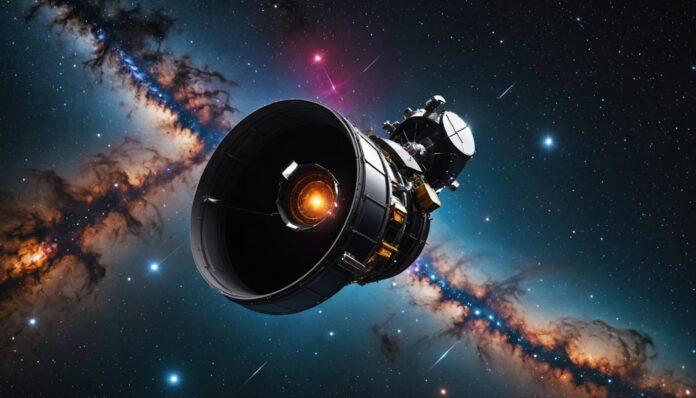

NASA's Roman Space Telescope left Earth on August 30, 2026, at 7:26 a.m. Eastern time, aboard a SpaceX Falcon Heavy rocket launched from the historic LC-39A pad at Kennedy Space Center in Florida. Thirty-one minutes and forty-one seconds after liftoff, the instrument separated from its launch vehicle to begin a three-month free-flight journey to its final destination: the second Sun-Earth Lagrange point, a gravitational balance point located about 1 million miles (1.6 million kilometers) from our planet.
Named in honor of Nancy Grace Roman, NASA's first chief astronomer, this telescope is a symbolic successor to Hubble and James Webb, without replacing either one: its mission is complementary. While Webb examines specific objects in fine detail, Roman is designed to map vast swaths of the sky to reveal phenomena invisible at a local scale, starting with dark matter and dark energy, the two components that govern the universe's expansion even though their exact nature remains poorly understood.
A Field of View a Hundred Times Larger Than Hubble's
Roman's strength lies in its field of view, roughly a hundred times wider than Hubble's, combined with comparable resolution. In practical terms, the observatory will be able to scan the sky a thousand times faster than its predecessor, allowing it to compile in just a few years surveys that Hubble could never have completed in an entire career. This large-scale survey capability makes it a prime tool for spotting new distant planets scattered throughout our galaxy, complementing missions already underway such as TESS.
At the heart of the observatory is the Wide Field Instrument, a 300-megapixel infrared camera made up of eighteen individual detectors, each barely larger than a cracker. This technical feat illustrates just how much emerging technologies are now transforming fields as different as space observation, industry, and information.
Three Major Scientific Missions
- Dark matter: measuring how this invisible matter shapes the large-scale structure of the universe, through the distortion of light from distant galaxies.
- Dark energy: tracking the acceleration of cosmic expansion by observing thousands of supernovae and how galaxies are distributed over time.
- Exoplanets: detecting worlds beyond our solar system using the gravitational microlensing technique, a method that has already confirmed an exoplanet through an effect predicted by Einstein.
Roman is thus expected to uncover thousands of additional exoplanets, including worlds farther from their star than those detected by the transit method typically used by other telescopes.
A Gradual Startup Through 2027
The telescope will not begin observing right away: several weeks will be needed to deploy and calibrate its instruments before the wide-field camera is activated. NASA plans to release the first images in early 2027, once the observatory has settled into its final orbit around the L2 Lagrange point. The science mission is then set to run for several years, with the goal of building one of the most comprehensive cosmic surveys ever conducted.
Frequently Asked Questions
Where is the Roman telescope today?
It is on its way to the second Sun-Earth Lagrange point (L2), about 1 million miles (1.6 million kilometers) from Earth, a journey expected to take roughly three months after its August 30, 2026 launch.
How does Roman differ from James Webb?
James Webb observes targeted objects in fine detail, while Roman is designed to scan vast swaths of the sky with a field of view a hundred times wider than Hubble's, in order to detect large-scale phenomena such as dark matter.
When will the first images be available?
NASA expects the first images in early 2027, once the telescope has settled into its orbit and its instruments have been calibrated.
Sources
S301: The 2026 Star Discovery That Will Put Einstein to the Test
At the heart of our galaxy, a star has just been spotted breaking every record: S301, detected using the European Southern Observatory (ESO), is hurtling around the Milky Way's supermassive black hole at the dizzying speed of 25,000 km/s, nearly…
A 1,000-Kilometer Icy Object Spotted Beyond Pluto, New Dwarf Planet Candidate
The solar system may have gained an additional dwarf planet. In late October 2026, the International Astronomical Union confirmed the discovery of an icy object nearly 1,000 kilometers in diameter orbiting far beyond Pluto, detected through the first observations of…
Diplodocus Fossil Discovered in Spain Rewrites the History of Dinosaurs in Europe
A dinosaur genus once thought to be exclusively North American has just been identified in Europe. Spanish paleontologists from the Dinópolis Foundation have unearthed, at the El Castellar site (Teruel), the first fossil remains definitively attributed to the genus Diplodocus,…
This article was written with the help of artificial intelligence. Editorial policy
Table des Matières

