






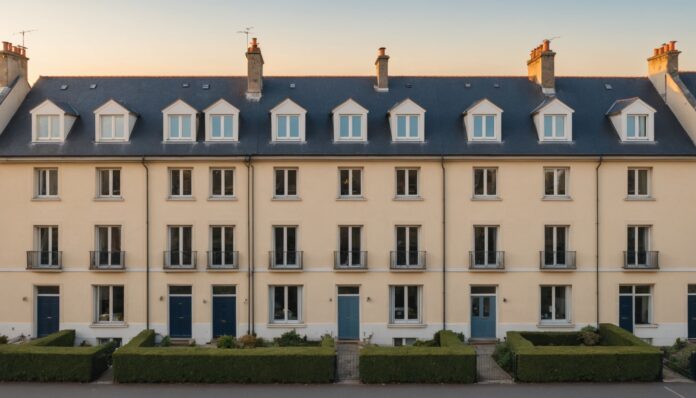

The existing-home market is confirming its recovery in France, but this momentum masks an increasingly clear divide between two types of properties. On one side, apartments are holding steady, with prices even stabilizing in several major cities. On the other, single-family houses continue to lose ground, year after year. This divergence is far from a minor detail, and it is reshaping the strategies of sellers and buyers alike.
A real recovery, but one that's losing steam
According to the Notaires de France (the French notaries' association), the volume of existing-home sales now stands at nearly 949,000 transactions over the twelve months ending in May, up year over year. The pace of this recovery, however, is slowing month after month: annual growth fell from more than 11% in February to around 5% in April, a sign of normalization rather than a market running hot. Volumes also remain about a quarter below the peak seen in the summer of 2021, proof that the return to normal remains gradual.
This upturn is benefiting first and foremost properties located in the most sought-after areas, while rural or suburban regions are struggling more to regain their pre-crisis momentum.
Apartments and houses: two diverging paths
The real story of this fall season lies less in the overall volume than in the widening gap between the two main property types. According to data from several specialized market trackers, existing apartments were still up 1.4% year over year at the end of 2025, compared with 0.7% for houses. In the first quarter of 2026, the gap widened further: apartments held onto a slight 0.6% increase, while houses slipped into negative territory with a 0.2% decline.
In the Paris region (Île-de-France), this trend is even more pronounced: apartment prices are ticking back up after several quarters of decline, driven by demand in major urban areas, while single-family houses keep retreating. Nationally, the average price per square meter now sits at around 3,100 euros, with sharp local disparities: some towns in the Paris region show price gaps that run from one to three times higher than another, depending on the city.
Why single-family houses are falling behind
Several factors explain this shift:
- The growing weight of the energy performance diagnostic (DPE) in negotiations, which penalizes large older houses more heavily, as they are often more energy-intensive than newer apartments.
- The cost of financing, which remains tight despite the stabilization of interest rates, which curbs access to the most expensive properties, often houses with land.
- A renewed appeal of city centers and university hubs, where supply is structurally dominated by apartments, to the detriment of more outlying suburban areas.
- An increasingly discouraging energy-renovation budget for buyers of older houses, which weighs heavily on the total cost calculation of the project.
Mid-sized cities with strong university and economic appeal, such as Rennes, Toulouse, Montpellier, and Bordeaux, are driving much of this momentum, buoyed by sustained demand for apartments. This reality is also prompting some house sellers to rethink their listing strategy, leaning more heavily on staging and presentation to stand out, as outlined in practical tips for showcasing a property before selling.
What this means for sellers and buyers
For owners of single-family houses, the challenge is twofold: adjust the asking price to the market's downward trend, while anticipating the energy-renovation work that will weigh increasingly heavily in negotiations. Conversely, owners of well-located apartments with good DPE ratings retain a position of strength, with generally shorter selling times. This period is also marked by heightened vigilance around real estate cold-calling, which is now more tightly regulated, also changing the way sellers and buyers are approached.
On the buyers' side, the window remains favorable for negotiating on single-family houses, where there is more room for discussion than a year ago. On apartments in major cities, by contrast, competition among buyers remains fierce and leaves little room for negotiation, particularly on energy-efficient properties.
Frequently Asked Questions
Is the existing-home market rebounding everywhere in France?
No. The recovery in transaction volume is real at the national level, but it is highly uneven across regions and property types. Major metropolitan areas and well-located apartments are benefiting more from this upturn than rural areas or single-family houses.
Why are houses selling less well than apartments right now?
The cost of financing, the weight of the energy performance diagnostic, and the associated renovation budget weigh proportionally more heavily on single-family houses, which are often larger and older, than on apartments.
Is now a good time to sell a single-family house?
It mainly depends on the property's location and energy rating. A favorable diagnostic and a price adjusted to the local market remain the best assets for selling under good conditions, despite an overall less favorable context for houses.
Sources
Notaires de France – Real Estate Market Report
Real Estate Barometer, August 2026
SeLoger – Real Estate Prices in France
Mortgage Rates: Why the Advertised Rate No Longer Tells the Whole Story
As fall 2026 begins, prospective buyers are watching their mortgage rate more closely than ever. Yet this figure, displayed prominently on online calculators, no longer tells the whole story. Between rising sovereign bond yields, banks' cautious stabilization, and the gradual…
Rental Lease: What the New Standard Contract Now Requires
Starting October 1, 2026, all residential leases signed or renewed in France will have to be based on a new standard rental contract. A decree published this summer reshuffles the mandatory clauses, with one concrete consequence for tenants and landlords…
Student Housing in France: A Tense Start to the School Year as Rents Keep Rising
With the start of the university year just days away, the student housing market in France confirms a strain that has already been building for several years. According to the latest specialized survey, rents charged to students are rising significantly…
MaPrimeRénov': Gas Now Excluded from Whole-House Renovations
As of September 1st, 2026, MaPrimeRénov' no longer funds keeping a gas boiler as part of a whole-house renovation for a single-family home in France. This shift, enacted by decree in late August, requires homeowners undertaking a major renovation to…
This article was written with the help of artificial intelligence. Editorial policy
Table des Matières

