






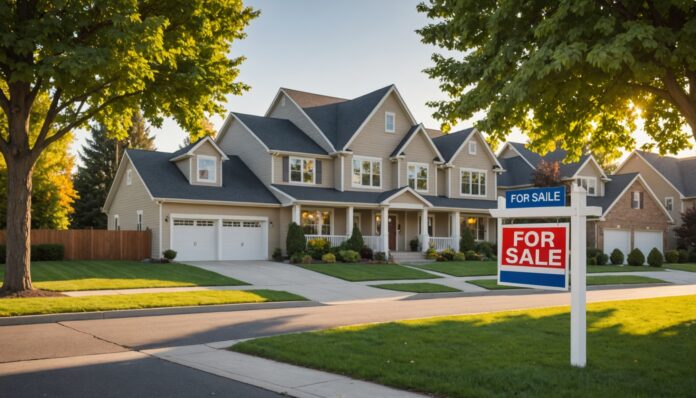

As fall 2026 begins, prospective buyers are watching their mortgage rate more closely than ever. Yet this figure, displayed prominently on online calculators, no longer tells the whole story. Between rising sovereign bond yields, banks' cautious stabilization, and the gradual return of buyers, the real cost of a loan is now determined by factors well beyond the nominal rate alone.
A rate that is stabilizing, but a tightening environment
After several months of calm between spring and early summer, average mortgage rates have held steady around 3.3% over fifteen years as of late August, with very slight downward adjustments at some lenders in July. This snapshot might be reassuring, if it didn't mask a more worrying underlying trend: the yield on French ten-year government bonds (OAT), the benchmark banks use to set their own rate schedules, has crossed the symbolic 4% threshold, a level not seen since 2009. Over the past year, the increase has exceeded 0.7 percentage points.
This gap between a mortgage rate that appears frozen and a bond market under pressure is creating a wait-and-see attitude among banks. Many prefer to freeze their rate schedules rather than lower them, lacking visibility on how the European Central Bank's key rates will evolve; the ECB paused at the end of July after a first rate hike in June, its first in three years.
The nominal rate, an increasingly misleading indicator
This is where the real change lies for borrowers this fall: the nominal rate is no longer enough to measure the real cost of a mortgage loan. Several items, long considered secondary, now weigh heavily on the final bill:
- Borrower's insurance, whose cost varies significantly depending on age, health, and the lender chosen, and which can account for up to a third of the total cost of the loan over a long term.
- Application and guarantee fees (mortgage lien or surety bond), rarely highlighted in quick online calculators but very real at signing.
- The loan term, which some households extend to limit their monthly payment, mechanically increasing the total cost even when the rate stays the same.
The result: two offers with the same nominal rate can end up with very different overall costs once these factors are taken into account. That's why it's worth comparing the annual percentage rate (APR) rather than just the nominal rate, and negotiating borrower's insurance separately through insurance delegation, the French right allowing borrowers to choose their own insurer instead of the bank's.
A market picking up despite banks' caution
Seemingly paradoxical: this tougher rate environment hasn't stopped the market from regaining some color. Over the twelve months ending in May, around 949,000 existing homes changed owners in France, an increase of nearly 6% year-over-year. New loan production, excluding renegotiations, jumped by a third to exceed 146 billion euros. Prices, meanwhile, remain broadly stable at the national level, with marked differences from city to city: some metropolitan areas, such as Lyon, have seen prices drop by more than 10% over five years, opening up opportunities for buyers who had long been priced out.
Industry professionals describe a market that is moving in fits and starts, where any economic or geopolitical news can slow down or revive purchasing decisions. This uncertain climate is pushing banks to remain selective about borrower profiles, while continuing to finance solid applications.
What this means for buyers
For a household considering a purchase in the coming months, fall 2026 calls for more careful preparation of their loan application: a stronger down payment, systematically comparing the total cost of the loan rather than just the rate, and anticipating bank processing times, which can stretch out during periods of high demand. Going through a broker or approaching several lenders remains, in this context, one of the most effective ways to limit the final bill.
Frequently Asked Questions
Will mortgage rates fall further by the end of the year?
There's no guarantee. As long as the yield on French ten-year government bonds stays close to 4%, banks' room to lower their rate schedules remains limited, even though slight, occasional adjustments remain possible depending on the lender.
Why can two offers at the same rate end up costing different amounts?
Because borrower's insurance, guarantee fees, and application fees vary from bank to bank. Only the APR, which factors in all of these costs, allows for a reliable comparison between two offers.
Is now a good time to buy despite rates being higher than a few years ago?
It mainly depends on each buyer's specific situation: in cities where prices have fallen, some projects are becoming affordable again. A case-by-case analysis, including the total cost of the loan and the stability of one's life plans, remains essential before making a decision.
Find more analysis and practical advice in our Real Estate section, as well as our articles on the economy and our tips for preparing your project.
Sources
- Le Point — analysis of the real cost of mortgage loans beyond the advertised rate.
- Les Echos — a breakdown of the risks facing borrowers this fall.
- Notaires de France (the French national notaries association) — data on sales volumes and price trends in the existing home market.
MaPrimeRénov': Gas Now Excluded from Whole-House Renovations
As of September 1st, 2026, MaPrimeRénov' no longer funds keeping a gas boiler as part of a whole-house renovation for a single-family home in France. This shift, enacted by decree in late August, requires homeowners undertaking a major renovation to…
Rental Lease: What the New Standard Contract Now Requires
Starting October 1, 2026, all residential leases signed or renewed in France will have to be based on a new standard rental contract. A decree published this summer reshuffles the mandatory clauses, with one concrete consequence for tenants and landlords…
Older Homes: Why Apartments Are Holding Up Better Than Houses
The existing-home market is confirming its recovery in France, but this momentum masks an increasingly clear divide between two types of properties. On one side, apartments are holding steady, with prices even stabilizing in several major cities. On the other,…
Student Housing in France: A Tense Start to the School Year as Rents Keep Rising
With the start of the university year just days away, the student housing market in France confirms a strain that has already been building for several years. According to the latest specialized survey, rents charged to students are rising significantly…
This article was written with the help of artificial intelligence. Editorial policy
Table des Matières

