






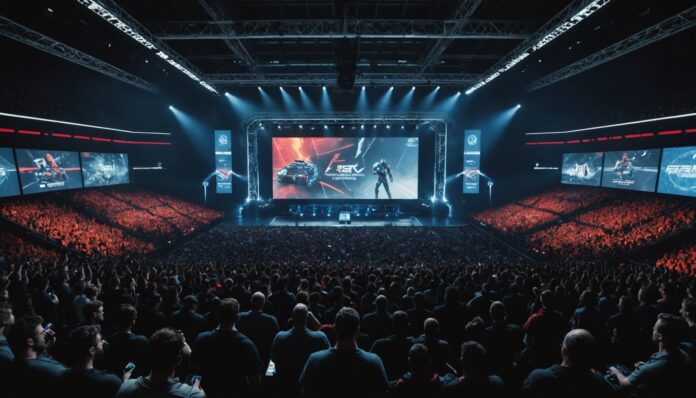

Since July 6, the Porte de Versailles has been far from a simple exhibition center: for seven weeks, it has become the stage for one of the biggest competitive video gaming events ever organized. The Esports World Cup wraps up there on August 23 with a figure that has traveled the world: a $75 million prize pool, an absolute record for an esports competition.
But behind the trophies and the highlights shared on social media, another story is unfolding: that of a country which, almost overnight, is becoming a global benchmark for an entire industry.
A tournament like no other, in every respect
The numbers for the 2026 edition are staggering. About 2,000 professional players, from more than 200 clubs and over 100 countries, competed in 25 tournaments spread across 24 different video games: League of Legends, Valorant, Counter-Strike, Fortnite, Call of Duty, Rocket League, Street Fighter, Overwatch, Rainbow Six, and EA Sports FC. Widely followed French teams such as Karmine Corp, Team Vitality, and Gentle Mates are among the 200 clubs involved.
The opening ceremony, held at the Seine Musicale in Boulogne-Billancourt on July 8, set the tone for an event designed as an all-out show, somewhere between sporting competition and mainstream entertainment. More than 100,000 tickets were sold for the full seven weeks of competition at the Porte de Versailles.
Why France, and why now
The detail least often highlighted in coverage of the event is actually the most revealing one: the Esports World Cup relocated to France in May 2026, after having been held in Saudi Arabia. The competition is funded by the Esports Foundation, which is itself backed by Saudi Arabia's Public Investment Fund, but it was the French Ministry of Sports that championed hosting the Paris edition, alongside the organizers.
This choice is part of a broader strategy by France to position itself as a host destination for major competitive video gaming events, continuing a momentum that began after the 2024 Paris Olympic Games. For a sector that is still young, landing a tournament with a $75 million prize pool offers an international showcase that would otherwise be hard to come by.
Economic impact that goes beyond video games
According to estimates released around the event, the indirect economic impact generated by the Esports World Cup for France could reach €600 million. That figure includes hotels, restaurants, tourism, and the activity generated around the exhibition venue over seven weeks, extending well beyond the video game sector alone.
- 2,000 professional players and more than 200 clubs represented
- Players from more than 100 countries
- 25 tournaments across 24 different video games
- A record $75 million prize pool
- More than 100,000 tickets sold at the Porte de Versailles
- An estimated €600 million in indirect economic impact
For France's video game and esports ecosystem, already growing strongly in recent years, an event of this kind acts as an accelerator: international visibility for domestic clubs and sponsors, an influx of visitors from abroad, and legitimacy for a discipline still seen by some as a marginal pastime.
Frequently Asked Questions
When does the Esports World Cup 2026 end in Paris?
The competition, which began on July 6 at the Porte de Versailles, wraps up on August 23, 2026, after seven weeks of tournaments across 24 video games.
Why did the Esports World Cup take place in France this year?
The event, usually held in Saudi Arabia by the Esports Foundation, relocated to France in May 2026, with support from the French Ministry of Sports, as part of an effort to boost international visibility for the competitive video gaming industry.
What is the prize pool for this edition?
The total prize pool amounts to $75 million, a record for an esports competition, split among the 25 tournaments held over the event's seven weeks.
Find more analysis on industry news in our Games and Casino section, along with our Economy and Tech / Net coverage.
Sources
Online Gambling in France: Where Does the Market Really Stand?
Sports betting, online poker, mobile video games: the online gambling sector continues to grow in France, driven by new entrants and increasingly mobile usage. The legal framework, however, remains strict. Here's what the regulator's latest figures show. A Market That…
Online Age Verification: Are Multiplayer Video Games Next in France?
After social media, could online video games be next? Since the definitive adoption, on July 21, 2026, of the law banning social media access for minors under 15 in France, a question has been stirring digital industry players: will the…
Sports Betting in France: Market Explodes After the 2026 World Cup, Advertising Under Scrutiny
The 2026 FIFA World Cup marked a turning point for the French sports betting market. Between surging wagers, the arrival of a new major player, and advertising pressure deemed excessive by the regulator, the sports betting industry in France is…
Loot Boxes and JONUM: What France's New Gaming Regulations Change
Long treated as two separate worlds, video games and gambling are increasingly converging — and French lawmakers are taking notice. Two measures that took effect in 2026 are redrawing the rules: on one side, the decree governing monetizable digital object…
This article was written with the help of artificial intelligence. Editorial policy
Table des Matières

