






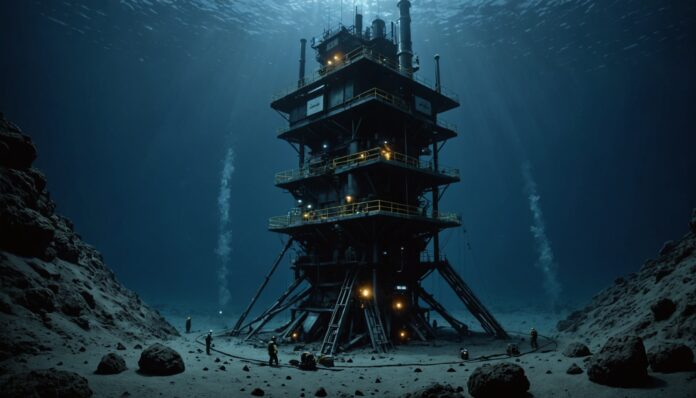

More than two kilometers below the surface of the Atlantic, France has just uncovered three deep-sea giants. During the Hermine 3 oceanographic expedition, a team led by Ifremer (the French Research Institute for Exploitation of the Sea) mapped three giant hydrothermal sites, long invisible, on the Mid-Atlantic Ridge. A discovery that sheds new light on the debate over deep-sea mining.
Three Giants Named After Breton Islands
Located between 21°N and 26°N, the three formations were given the names of Breton islands: Enez Sun, Enez Houad, and Enez Edig. The largest, Enez Sun, rises 100 meters high and spans 300 meters in diameter at a depth of 2,300 meters—nearly twice the size of the Colosseum in Rome. The other two sit at a depth of around 1,200 meters. All are made up of polymetallic sulfides rich in iron, copper, and zinc, accumulated over tens of thousands of years.
They were believed to be completely extinct. Yet Enez Sun delivered a surprise: a slight thermal anomaly of 0.8°C above the surrounding water (3.6°C), associated with bacterial mats. The giant, then, may not be entirely dormant after all.
Robots to Probe the Darkness
The feat lies as much in the discoveries as in the resources deployed. From March 1 to April 17, 2026, the research vessel Pourquoi pas ? served as a base for two complementary vehicles: the crewed submersible Nautile, in service since 1984, and the autonomous drone UlyX, which joined the fleet in 2024. The latter covered up to 173 square kilometers of ocean floor per night, allowing scientists to later target 24 direct observation dives.
As Ewan Pelleter, a geologist at Ifremer and co-leader of the mission, sums it up, “this hydrothermal mount is a very ancient, world-class object.” Around these mineral chimneys, a still poorly understood biodiversity is developing, which the samples brought back will help decode.
Why These Discoveries Matter
These formations are not mere geological curiosities. Concentrating sought-after metals, they lie at the heart of international negotiations over deep-sea mineral resources. Since 2016, France and Ifremer have advocated for the protection of active hydrothermal sites against extraction projects. Better understanding these formations, whether active or ancient, thus becomes a scientific, ecological, and diplomatic issue.
- Scientific stakes: understanding how these chimneys form, live, and die out over tens of thousands of years.
- Ecological stakes: documenting rare ecosystems before any decision on mining.
- Strategic stakes: carrying weight in global debates over access to deep-sea metals.
Mapping these three sites illustrates a simple idea: we still know very little about our blue planet, whose vast majority of terrain lies hidden beneath the waves. Each expedition pushes the boundaries of this exploration a little further.
Frequently Asked Questions
What is a hydrothermal site?
It's an area of the seafloor where water, heated by contact with magma beneath the oceanic crust, rises back up laden with minerals. As it cools, these minerals settle and build, century after century, chimneys and sulfide mounds that can reach dozens of meters in height.
Are these sites dangerous for the environment if they are mined?
Scientists warn about the fragility of the ecosystems surrounding them. Mining extraction could destroy unique habitats that are very slow to recover, hence the call for caution from France and Ifremer.
Why Breton island names?
French oceanographic tradition often leaves it to teams to name their discoveries. Enez Sun, Enez Houad, and Enez Edig echo Breton islands, a nod to the Brittany-based laboratories heavily involved in the mission.
Sources
- Ifremer — Major discovery of three ancient hydrothermal sites
- Mer et Marine — Three “world-class” hydrothermal sites
- Actu-Environnement — Three ancient hydrothermal sites discovered
To keep up with ocean and nature news, explore our Planet section, our Science articles, and our Economy analyses.
American Giant Liver Fluke: A New Parasite Takes Hold in French Deer
A parasite previously unknown on French soil has just been detected in the liver of a fallow deer in Sologne. Named the American giant liver fluke (Fascioloides magna), this invasive species native to North America attacks wild deer and is…
Biodiversity in France: What the New European Report on Species Status Reveals
A new scientific report serves as a reminder that biodiversity in France continues to decline, despite decades of protection policies. Published in early September by the National Museum of Natural History and the French Biodiversity Office, this document—largely overlooked by…
Japanese Beetle in France: Why This Insect Is Causing So Much Concern in 2026
Since the start of summer 2026, a small metallic beetle with coppery-green highlights has been keeping France's plant health monitoring services busy. The Japanese beetle (Popillia japonica) has been detected several times across the country, reviving concern among farmers and…
Alstom's Belfort Plant Ramps Up: New Locomotives, New Building, 200 New Jobs
In the Territoire de Belfort, the Alstom plant is heading into a packed fall season. Chosen to produce an entirely new line of locomotives meant to replace an aging diesel fleet, the Belfort industrial site is also announcing the upcoming…
This article was written with the help of artificial intelligence. Editorial policy
Table des Matières

