






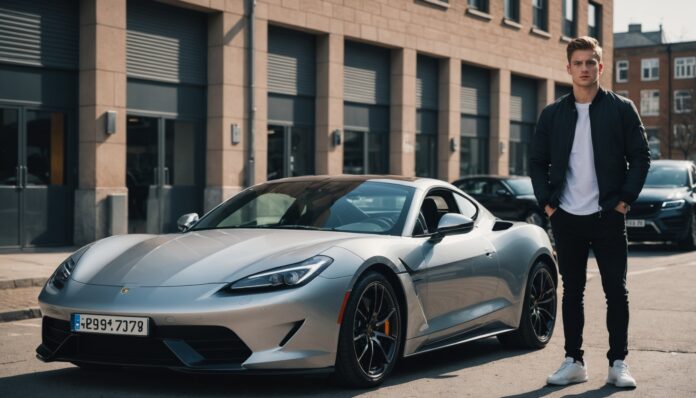

Since mid-July 2026, the Ripost law has changed the rules for many driver's license holders in France. Certain young drivers can no longer get behind the wheel of cars deemed too powerful, under penalty of heavy sanctions. The law, presented as a road safety measure, nonetheless remains vague on one essential point: the power threshold that triggers the ban.
Who is affected by this ban?
The restriction targets drivers on a probationary license, meaning people who recently obtained their driver's license. This probationary period lasts three years after completing standard driving school training, but it is reduced to two years for candidates who went through accompanied driving or supervised driving programs. During this phase, access to certain powerful vehicles is now off-limits to them.
The measure is not limited to individuals: car rental companies and businesses that provide a vehicle to an employee on a probationary license are also subject to the new verification requirements.
What are the penalties for non-compliance?
The consequences set out by the law are severe. A driver caught behind the wheel of a prohibited vehicle during their probationary period faces up to one year in prison and a 15,000-euro fine. On the professional side, rental companies or employers who provide this type of vehicle to a young driver risk a fine of up to 1,500 euros.
This scale places the Ripost law among the strictest measures ever adopted regarding road safety for novice drivers, a category statistically overrepresented in serious accidents.
The lingering uncertainty over the power threshold
The most discussed aspect of the law remains, to this day, its lack of precision. No numerical power threshold (horsepower, power-to-weight ratio, or engine displacement) has yet been set in the law itself: an implementing decree, expected in fall 2026, is meant to specify the exact criteria defining a car that is “too powerful.” Until it is published, new license holders and rental industry professionals alike are operating in a zone of legal uncertainty.
This lack of a clear criterion complicates both the choice of a first car and the management of rental fleets, with some rental companies already choosing to pull the most powerful models from their lineup as a precaution.
How to prepare before the decree is published
- Find out the fiscal and actual horsepower of the vehicle you are considering before buying or renting
- When in doubt, favor an entry-level or mid-range model rather than a sporty version
- Check with your insurer whether specific clauses already exist for drivers on a probationary license
- Follow the publication of the implementing decree in fall 2026 to learn the final threshold
Until these details are clarified, caution is best treated as the young driver's best ally, both to comply with the law and to limit risks on the road. Find more analysis in our Automotive section, as well as our practical Tips on driving and car buying.
On the budget side, this type of restriction can also influence families' purchasing decisions; our Consumer section regularly offers guidance for weighing different models against each other.
Frequently Asked Questions
When does the Ripost law take effect?
The law went into effect in mid-July 2026. It is therefore already in force, even though the decree specifying the prohibited power threshold is not expected until fall 2026.
How long does the relevant probationary period last?
It lasts three years after obtaining a license through standard driving school training, and is reduced to two years for drivers who went through accompanied or supervised driving programs.
What risk does a young driver face if caught in violation?
The driver faces a fine of up to 15,000 euros and a maximum sentence of one year in prison. Companies or rental agencies at fault risk a fine of up to 1,500 euros.
Sources
French Auto Market: Tesla and Chinese Brands Accelerate as Renault Falls Back
The French auto market posted growth of +3.1% over the first sixteen business days of August, according to AAA Data figures. A fairly flattering number on the surface, but one that hides a mixed reality: while legacy automakers are losing…
Xiaomi SU7: Why the Electric Car Is Already on French Roads Without Being Sold There in 2026
A pink prototype, bristling with measurement sensors, was photographed driving around Alsace in recent days. Its model: the Xiaomi SU7, the electric sedan that has shaken up the Chinese market since its launch. The problem: this car still isn't sold…
Paris Motor Show 2026: What Awaits Visitors at Porte de Versailles
The 2026 Paris Motor Show will take place at the Paris Expo exhibition center at Porte de Versailles, in Paris, from October 12 to 18, 2026. For this 91st edition, the world's oldest auto show is showing renewed ambition: more…
Electric Cars: The Mileage Tax Is Coming to the UK, Not France
A rumor keeps circulating on social media: France is supposedly about to start charging electric car owners by the mile driven. It originates across the Channel, where the United Kingdom has just officially set in stone a mileage tax for…
This article was written with the help of artificial intelligence. Editorial policy
Table des Matières

