






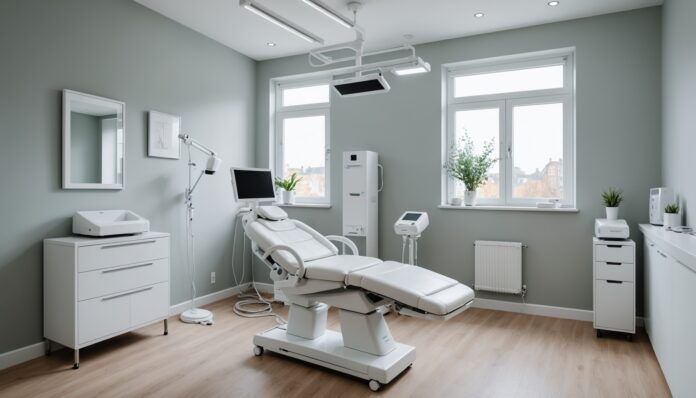

Finding the right place for laser hair removal in Paris is no small matter: regulations have changed, techniques vary from one center to another, and a poor choice can prove costly, both financially and in terms of results. Here are the criteria that make the difference before booking a first session. This guide complements our article on how to choose laser hair removal for smooth skin all year round, this time digging deeper into safety and the criteria for selecting a center.
Who is allowed to perform laser hair removal today
Since decree no. 2024-470 of May 24, 2024 and its implementing order of February 19, 2025, hair removal using intense pulsed light or non-therapeutic laser is no longer reserved solely for doctors. It can now be performed by physicians, state-registered nurses, and beauty professionals who can demonstrate mandatory specific training validated by health authorities — a substantial change after more than sixty years during which only the medical profession was authorized to do so. This legal framework should be the first thing to check before walking into a salon: asking whether the practitioner has completed this training is not indiscreet at all — it is the client's right.
The criteria for choosing the right center in Paris
The number of addresses offering this service has risen sharply in the capital, making comparison essential. A few benchmarks help sort out which establishments are serious: a skin phototype assessment performed before the first session, a recent-generation device suited to the skin type — in keeping with the innovations currently transforming body and skin care — a consultation that openly addresses contraindications, and prices communicated clearly zone by zone. To get a sense of the expected standards, it's also worth looking at well-established centers that provide some of the best laser hair removal Paris has to offer: this type of practice serves as a useful benchmark, particularly when it comes to how the initial consultation unfolds and the follow-up between sessions. It also remains essential to compare several quotes before committing, since prices for the same zone can vary by as much as double from one center to another.
Contraindications and precautions to know
Certain situations call for postponing or ruling out treatment: pregnancy, taking photosensitizing medications such as retinoids or certain antibiotics, an active skin infection, a history of keloid scarring, or a suspicious skin lesion. Recent sun exposure is also a serious obstacle: responsible practitioners recommend waiting about four weeks after sun exposure, because the laser can mistake the melanin in the hair for that of tanned skin, increasing the risk of burns or pigmentation spots. After the session, soothing the treated area with a gentle, non-irritating product containing ingredients such as aloe vera, for example, is one of the recommended steps to limit temporary redness.
How many sessions and what budget to plan for
Results are never achieved in a single session: generally plan on between 6 and 10 sessions spaced six to eight weeks apart for a lasting result, sometimes more on the face, where regrowth is more unpredictable. As for budget, small areas (underarms, upper lip) typically range from €40 to €70 per session, medium areas (bikini line, half-legs) from €80 to €150, and large areas (full legs, back) from €180 to €300. A package combining several areas usually saves 10 to 20 percent compared to booking sessions separately. These amounts are only indicative: they vary significantly from one center to another, which is why it's worth comparing several detailed quotes before committing to a full package.
Mistakes to avoid
- Booking the first session right after a sun vacation, without respecting the skin's required rest period.
- Choosing solely based on price, without checking the practitioner's training or the type of device used.
- Stopping the protocol halfway through: hairs in the resting phase haven't been treated yet and will grow back.
- Neglecting skin care between sessions, when well-prepared skin responds better to treatment.
Frequently asked questions
Does laser hair removal hurt?
The sensation is most often described as a slight pinch or a feeling of warmth, varying depending on the area and each person's sensitivity. Recent devices generally include a cooling system that significantly reduces discomfort compared to earlier generations of lasers.
Is the result really permanent?
The laser acts on hairs in the active growth phase, which is why several sessions spaced apart are needed to treat the entire hair cycle. Once the full protocol is complete, regrowth is greatly reduced and generally finer, though a few annual touch-up sessions can still be useful depending on the area and hormonal profile.
Can laser hair removal be done on dark or darker skin?
Yes, provided the center has a device suited to darker phototypes, generally based on Nd:YAG technology, and that a skin assessment is performed before the first session. This is a point to check explicitly during the consultation, since not all devices are suitable for all skin types.
Sources
Ministry of Health — new regulations on intense pulsed light and laser hair removal
Légifrance — decree no. 2024-470 of May 24, 2024
MACSF — non-therapeutic intense pulsed light and laser hair removal
Online Doctor: When to Consult, How to Choose, and What to Watch For
Consulting an online doctor has become second nature for millions of people in France: a passing bout of fatigue, renewing a prescription, a quick opinion before heading to the emergency room. But not all situations are equal, and neither are…
Sustainable Weight Loss: Mistakes to Avoid and What Actually Works
Weight loss remains one of the most sought-after health goals, but also one of the most poorly approached: crash diets, promises of results in just a few days, extreme deprivation… These methods weaken the body and almost always end with…
This article was written with the help of artificial intelligence. Editorial policy
Table des Matières

