






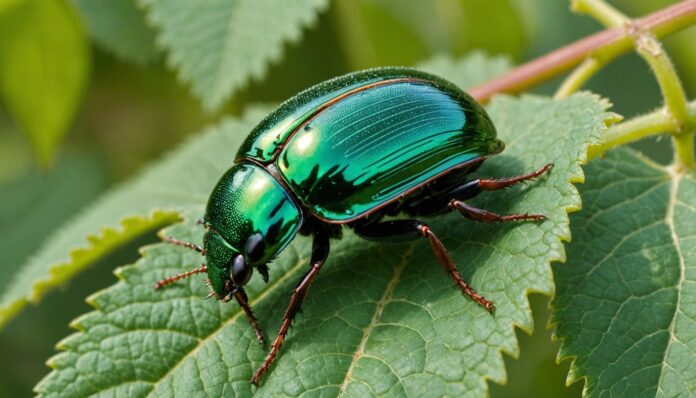

Since the start of summer 2026, a small metallic beetle with coppery-green highlights has been keeping France's plant health monitoring services busy. The Japanese beetle (Popillia japonica) has been detected several times across the country, reviving concern among farmers and gardeners alike. Barely an inch long, the insect is nonetheless ranked among the most closely watched threats in Europe. Here is what's actually changing this year, and why this level of vigilance is far from excessive.
Multiple Detections in France in 2026
The 2026 season confirms that the phenomenon has moved well beyond the initial introduction stage. A first individual was captured on June 16 in Écot, in the Doubs department, an identification confirmed on June 22 by the national reference laboratory of the Anses (the French food, environmental, and occupational health safety agency). Other sightings followed: a specimen in Cannes, in the Alpes-Maritimes, then a trapped beetle in Côte-d'Or in early July, near a major highway. In mid-July, two beetles were captured for the first time in the Grand Est region, near Strasbourg.
In most cases, these appear to be isolated individuals, nicknamed “hitchhikers,” that likely traveled by road transport. This passive mode of spread is precisely what makes the species so difficult to contain: it rides logistics flows to cover hundreds of miles.
Why Is This Beetle So Feared?
The Japanese beetle is a particularly polyphagous pest. It attacks more than 300 plant species, including grapevines, fruit trees, corn, soybeans, and lawns. Adults devour foliage while larvae attack roots, multiplying the points of attack on a single plot.
The European Union has classified it as a priority quarantine organism, a status reserved for the pests considered most dangerous. First detected on the continent in 2014, near Milan-Malpensa Airport, it is now permanently established in Italy, the Azores, and Switzerland, and remains present on a transient basis in Spain, Slovenia, and France.
Considerable Economic Stakes
The figures put forward by researchers show the scale of the risk. A Europe-wide study estimates that, without management measures, damage caused by Popillia japonica could cost between 30 million and 7.8 billion euros a year, depending on the level of infestation and the crops affected. In the Italian regions already colonized, such as Lombardy and Piedmont, crop losses of up to 70% have been observed locally.
- Vineyards: defoliation that can weaken vines and reduce the harvest.
- Orchards and gardens: leaves stripped down to their veins on many ornamental and fruit species.
- Field crops: corn and soybeans are among the listed targets.
What Every Citizen Can Do
Given a spread that largely depends on human movement, early detection is the most effective weapon. Prefectural authorities are stepping up calls for reporting and expanding trapping efforts, particularly along highways. A few simple actions can help with monitoring:
- Learn to recognize the insect: a metallic green body and coppery wing covers, with small tufts of white hair along the sides of the abdomen.
- Photograph any suspicious specimen without releasing it.
- Report it to regional services (the Draaf regional agriculture departments, Fredon plant health networks) or through official reporting platforms.
- Check vehicles, trailers, and plants when traveling from known infestation areas.
Frequently Asked Questions
Is the Japanese beetle dangerous to humans?
No. The insect does not sting and poses no health risk to people or animals. The risk is purely agricultural and environmental, due to the damage it inflicts on plants.
How can it be told apart from a common June bug?
Its most reliable feature is the presence of five small tufts of white hair on each side of the abdomen, plus two more at the rear. Its metallic green color with coppery highlights also makes it recognizable.
What should I do if I find one in my garden?
Don't release it. Take a photo, keep it in a closed container if possible, and report it promptly to your region's plant health services. A quick report helps limit the species' establishment.
A Real-World Test for Surveillance
The repeated detections in 2026 don't mean France is being overrun, but they do illustrate the constant pressure this species places on plant health borders. Between climate change, which is expanding favorable zones, and intensifying trade, the trajectory of the Japanese beetle is a good indicator of our collective ability to react quickly to invasive species. To dig deeper into these topics, check out our analyses in the Planet section, our practical gardening tips, and our in-depth coverage in Science.
Sources
- La France Agricole — Popillia japonica detected in France in 2026
- Fredon — First detection in Bourgogne-Franche-Comté
- EFSA — Pest report on Popillia japonica
Biodiversity in France: What the New European Report on Species Status Reveals
A new scientific report serves as a reminder that biodiversity in France continues to decline, despite decades of protection policies. Published in early September by the National Museum of Natural History and the French Biodiversity Office, this document—largely overlooked by…
Mid-Atlantic Ridge: Three Giant Hydrothermal Sites Revealed in the Deep Sea
More than two kilometers below the surface of the Atlantic, France has just uncovered three deep-sea giants. During the Hermine 3 oceanographic expedition, a team led by Ifremer (the French Research Institute for Exploitation of the Sea) mapped three giant…
American Giant Liver Fluke: A New Parasite Takes Hold in French Deer
A parasite previously unknown on French soil has just been detected in the liver of a fallow deer in Sologne. Named the American giant liver fluke (Fascioloides magna), this invasive species native to North America attacks wild deer and is…
Alstom's Belfort Plant Ramps Up: New Locomotives, New Building, 200 New Jobs
In the Territoire de Belfort, the Alstom plant is heading into a packed fall season. Chosen to produce an entirely new line of locomotives meant to replace an aging diesel fleet, the Belfort industrial site is also announcing the upcoming…
This article was written with the help of artificial intelligence. Editorial policy
Table des Matières

 has been detected again in France in 2026. A threat to vineyards and gardens, with key figures and helpful tips.)