







Renting out a furnished property instead of an unfurnished one is attracting more and more landlords in France, and LMNP status (loueur en meublé non professionnel, or non-professional furnished rental landlord) is often the first option that comes up. But between income thresholds, the choice of tax regime, and reporting obligations, the matter remains technical. Here are the concrete benchmarks to navigate it without getting lost in administrative details.
Who Can Become a Non-Professional Furnished Rental Landlord?
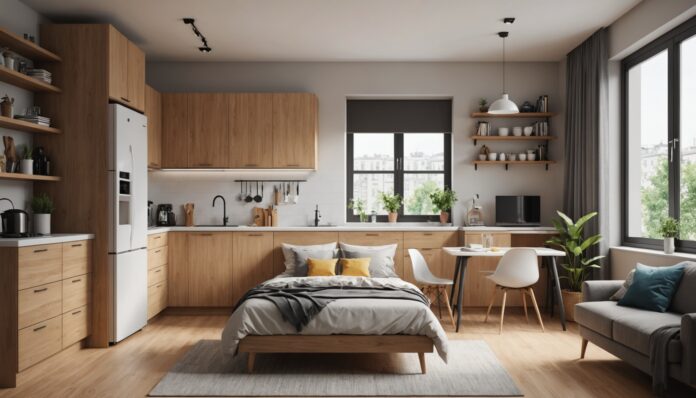
LMNP status is open to anyone who rents out a furnished home equipped for someone to live in normally (bed, table, cooktop, refrigerator…), according to the list set by decree No. 2015-981 of July 31, 2015. Three conditions must all be met: not being registered with the Trade and Companies Register (RCS) for this activity, and earning rental income that remains below €23,000 per year or below the household's other earned income. Beyond that threshold, the landlord automatically shifts to professional furnished rental landlord (LMP) status, which comes with a different social and tax regime. The activity must also be declared within 15 days of starting, through the single window for business formalities (guichet unique).
For an initial overview of the process and the applicable tax rules, head to the rental property tax service, which walks through the registration steps one by one. This status is also appealing because it adapts to several formats, from a student studio rented year-round to a furnished vacation rental offered in summer: many landlords see it as a way to generate income from a second home that sits underused part of the year.
Micro-BIC or Actual Regime: The Choice That Changes Everything
Two tax regimes coexist, and picking the wrong one can be costly. The micro-BIC regime applies by default: it grants a flat 50% deduction on income for a standard furnished rental, as long as income doesn't exceed €83,600 per year (the cap and the deduction drop to €15,000 and 30%, respectively, for an unclassified furnished vacation rental). Simple to report, this regime nonetheless becomes disadvantageous once actual expenses — loan interest, renovation work, condo fees — exceed 50% of rent collected.
The actual regime (régime réel), which must be elected, allows the full deduction of expenses as well as depreciation of the property. It applies automatically beyond the micro-BIC cap, and up to €286,000 in income under the simplified actual regime. It's often the more favorable regime once a loan finances the purchase, since the interest directly reduces taxable income. Before deciding, it's best to compare this calculation against the rental yields actually observed in the target market, since a good tax regime never makes up for a poor location.
Depreciation, the Actual Regime's Tax Weapon
This is the most commonly misunderstood advantage of the system. Under the actual regime, the property and furnishings can be depreciated — that is, deducted from taxable income each year as an accounting expense, with no actual cash outlay. The calculation is done by component (structural work, roofing, electrical systems, furnishings…), each with its own depreciation period, with the land being the only portion that cannot be depreciated. Used well, this depreciation offsets a large share, sometimes all, of the tax on rental income for several years. One limit does apply, however: depreciation cannot create a tax loss; any unused portion is simply carried forward with no time limit.
Some investors weigh this mechanism against other schemes, such as rental investment under the Pinel law for new construction: the logic is different — one reduces tax through a direct tax-break mechanism, the other through the accounting deduction of an expense — and the choice depends mainly on the planned holding period.
The Mistakes That Cost the Most
- Opting for the actual regime without first having a depreciation schedule drawn up by a professional: a calculation error carries through several years of tax filings.
- Neglecting the lease agreement: a furnished rental contract follows its own rules, distinct from an unfurnished rental, and the standard lease template now requires mandatory disclosures that must be included for a furnished rental.
- Forgetting to watch the €23,000 threshold: exceeding it triggers a shift to professional status, with social and tax consequences that can't be anticipated overnight.
Frequently Asked Questions
Do You Need to Own the Property to Become an LMNP Landlord?
Yes, the status requires renting out a property you own or hold as a bare owner; a tenant cannot sublet it as a furnished rental under this status without the landlord's explicit consent.
Can You Switch Tax Regimes Along the Way?
Yes, electing the actual regime is done each year before a deadline set by the tax authorities; conversely, switching back to the micro-BIC regime requires meeting a minimum commitment period.
Is LMNP Status Compatible With a Property Rented Through a Short-Term Rental Platform?
Yes, provided you follow the local rules (registration with the town hall, registration number) that apply, for these rentals, in addition to the tax obligations of LMNP status.
Sources
- Bpifrance Création — Furnished Rental Landlord
- PAP.fr — How Depreciation Works Under LMNP
- Service-public.fr — Furnished Vacation Rental
Notary Fees: How They're Calculated and What You Can Actually Negotiate
Signing a preliminary sales agreement without anticipating the real cost of the transaction is one of the most common mistakes made by first-time buyers. Notary fees often amount to several thousand euros, but the amount varies significantly depending on whether…
This article was written with the help of artificial intelligence. Editorial policy
Table des Matières

